AI isn’t so much inventing new cyber threats as industrialising old ones, making attacks faster, more convincing and easier to launch. Bede Gaming’s Chief Technology Officer, Dan Whiteley, explains what that means for iGaming operators, and why defences need to evolve just as quickly.
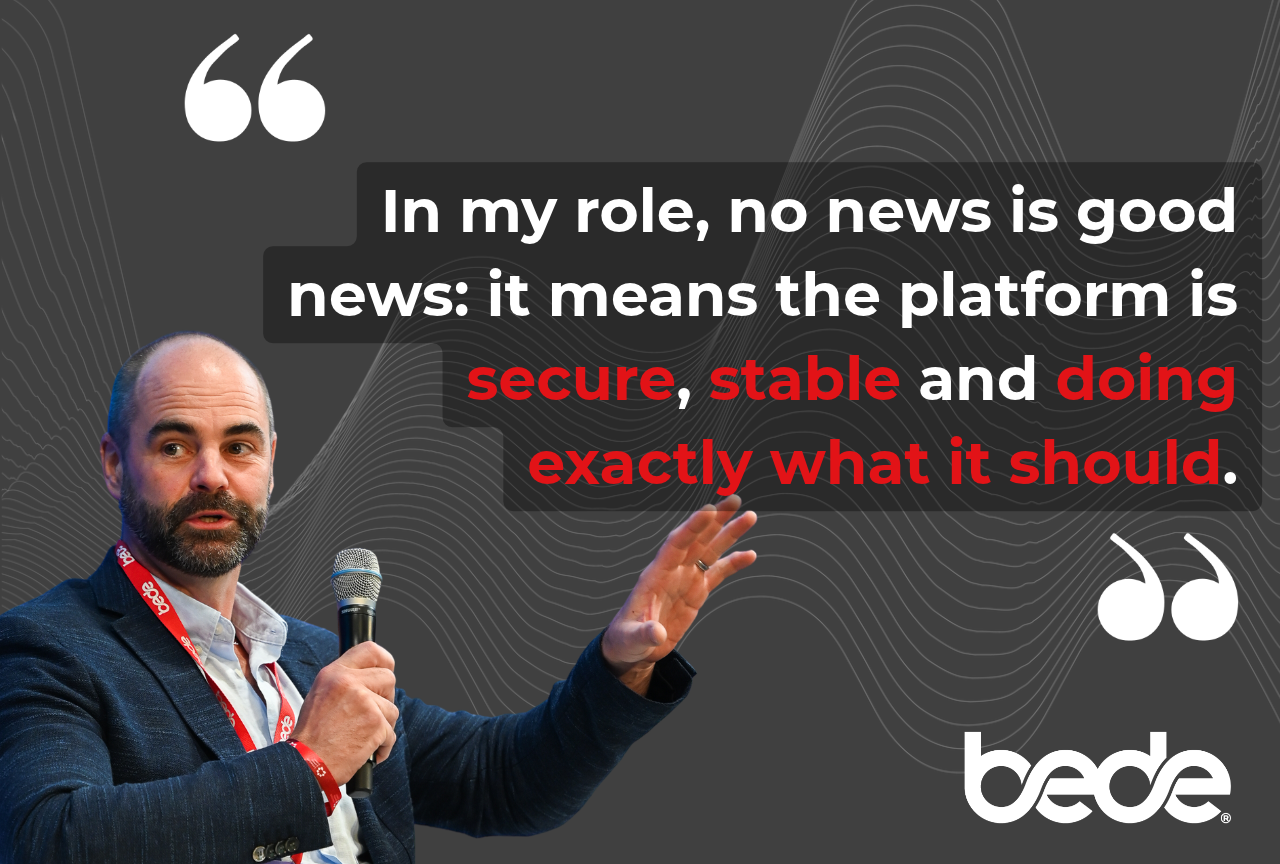
Few industries present a more attractive target to cybercriminals than iGaming. Operators hold large volumes of personal and financial data, process high transaction volumes around the clock, and depend on a web of integrations with payment providers, game studios, responsible gambling tools and other third-party services. Availability is critical, because every minute of downtime affects both revenue and player trust. In my role, no news is good news: it means the platform is secure, stable and doing exactly what it should.
Cyber threats are nothing new to our industry. What’s changing is the economics of attacking. A few years ago, anyone trying to break into a system needed real technical knowledge: how networks work, how identity and access are managed, and how to exploit weaknesses in people or technology. AI is beginning to democratise those capabilities. It lowers the skill needed to launch a sophisticated attack, increases the speed at which attacks can be carried out, and makes established techniques far harder to spot. The threats themselves are familiar. The scale and precision are not.
Social Engineering Gets Personal
Phishing and smishing used to depend on volume: generic messages sent to as many people as possible, in the hope that a few would click. AI changes that. Attackers can now produce highly personalised messages at scale that mirror the tone, timing and context of genuine business emails, texts and supplier correspondence. The tell-tale signs we’ve all been trained to look for, such as poor grammar or generic greetings, are disappearing.
AI-generated voice and video takes this further. Convincing impersonations of colleagues, executives, suppliers and partners can be used to pressure staff into sharing credentials, approving payments or granting access to critical systems. In a fast-moving operational environment, a familiar voice on a call asking for something urgent is a powerful lever.
In my view, the defence is as much about process as technology. Phishing-resistant multi-factor authentication, verification steps for payment and access requests that don’t rely on the channel the request came in on, and awareness training that reflects how these attacks look today all reduce the chances of a convincing message turning into a breach.
Account Takeover At Scale
Account takeover remains one of the most persistent threats to operators. Attackers rarely need to find a software vulnerability. They use usernames and passwords exposed in earlier breaches elsewhere and test them against gaming platforms at scale.
AI is making these credential stuffing campaigns more efficient and harder to detect. Automated tools can prioritise likely targets, spread attempts out to avoid triggering limits, and imitate the behaviour of genuine players closely enough to slip past basic controls. Once inside an account, attackers can withdraw balances, abuse bonuses or use the account as part of wider fraud.
Effective protection combines strong authentication, bot detection and behavioural analysis that can tell the difference between a real player and an automated script behaving like one, along with rapid response when an account shows signs of compromise.
Availability Under Pressure
Distributed denial-of-service (DDoS) attacks are still fundamentally about overwhelming systems with traffic. AI is now helping attackers carry them out more intelligently: speeding up reconnaissance, probing for weak points, and adapting the attack in response to defences as it unfolds. Combined with readily available attack-for-hire services, this puts disruptive capability within reach of far less sophisticated actors.
For gaming platforms, where peak events and live play leave little tolerance for disruption, resilience has to be designed in from the start. We work towards zero downtime, and that means scalable infrastructure, layered traffic filtering, continuous monitoring and mitigation that can adapt as quickly as the attack does.
The Supply Chain Is Part Of The Attack Surface
An operator’s security is only as strong as the weakest link in its ecosystem. Every payment provider, content supplier and third-party integration is a potential entry point, and attackers increasingly target suppliers as a route to the organisations they serve. As a platform provider, we take that responsibility seriously. Understanding how partners secure their own systems, limiting each integration to the access it actually needs, and monitoring those connections continuously are now essential parts of any security strategy.
AI Inside The Business
There’s a further dimension I think gets too little attention: the AI tools organisations are adopting themselves. I’m a strong advocate of AI, and we’re embracing it across Bede. But assistants and agents that connect to internal systems and data can create new routes for data leakage if they aren’t governed carefully. With technologies such as Model Context Protocol (MCP) making it easier to connect AI to internal tooling, businesses need a clear understanding of how everything is connected and where the vulnerabilities lie.
That’s why we’ve set firm boundaries. Our AI policies govern which tools can access what, sensitive data stays within controlled environments, and we don’t allow autonomous AI agents to operate freely in our production environments.
Bede’s Approach
At Bede, we treat security the way we treat responsible gambling: it’s built into our technology, processes and culture from the start, never added afterwards. We take a layered approach designed to prevent, detect and respond to threats, underpinned by continuous monitoring, risk management and ongoing improvement.
Our controls and governance are independently audited to SOC 2, providing assurance over how we protect customer data and maintain the secure, reliable operation of our platform. Our Network Operations Centre (NOC) and Security Operations Centre (SOC) monitor the platform 24/7, so we can identify and respond to issues quickly, whenever they happen. Alongside strong access controls and ongoing security awareness training, we continue to invest in infrastructure resilience and threat detection to keep our partners’ platforms available.
We’re also looking at where AI can take this further. Malicious actors will inevitably use the latest models to their advantage, so defenders need to do the same. We’re exploring AIOps and the idea of an AI sentinel: always on, always watching, analysing signals across the platform in real time to spot anomalies and emerging threats earlier than any team could alone. As with everything we do in AI, the principle is that it observes, analyses and recommends, while our people decide and act.
The threat landscape will keep evolving, and AI will keep accelerating it. Our job is to stay ahead of that curve: to protect our platform, the operators who rely on it, and the players who trust it.